Why Do Veneers Fail? A Fracture Is Not a Diagnosis
In short / the answer
A fracture is the outcome, not the diagnosis. What the veneer was bonded to, how the tooth was prepared and how the bite loads it all contribute.
When a veneer breaks, the first instinct is to blame the ceramic. But the fracture is the outcome, not necessarily the cause. Before replacing it, I want to understand what it was bonded to, how the tooth was prepared and where the forces were going. Otherwise, we may simply reproduce the same problem.
What actually fails, in the published series
Fracture leads, and debonding follows it. In a retrospective series of 580 veneers followed for up to twelve years, the commonest single failure type was fracture. That pattern is consistent enough across the literature to be a reasonable starting assumption in the chair.
Survival percentages are quoted a great deal and compared far too freely. Different series use different patients, different operators, different definitions of what counts as a failure and different lengths of follow-up, so putting one study's figure beside another's tells you very little. What is worth reading across studies is not the headline number. It is which variables moved the risk.
The two variables that keep appearing
The first is what the veneer is bonded to. In the 580-veneer series, restorations bonded to dentin, or with margins finishing in dentin, were around ten times more likely to fail than those bonded to enamel. In the 672-veneer series, any dentin exposure carried an odds ratio of 3.47, and survival fell from 96.7% where the preparation stayed in enamel to 93.9% where more than 30% of the surface was dentin.
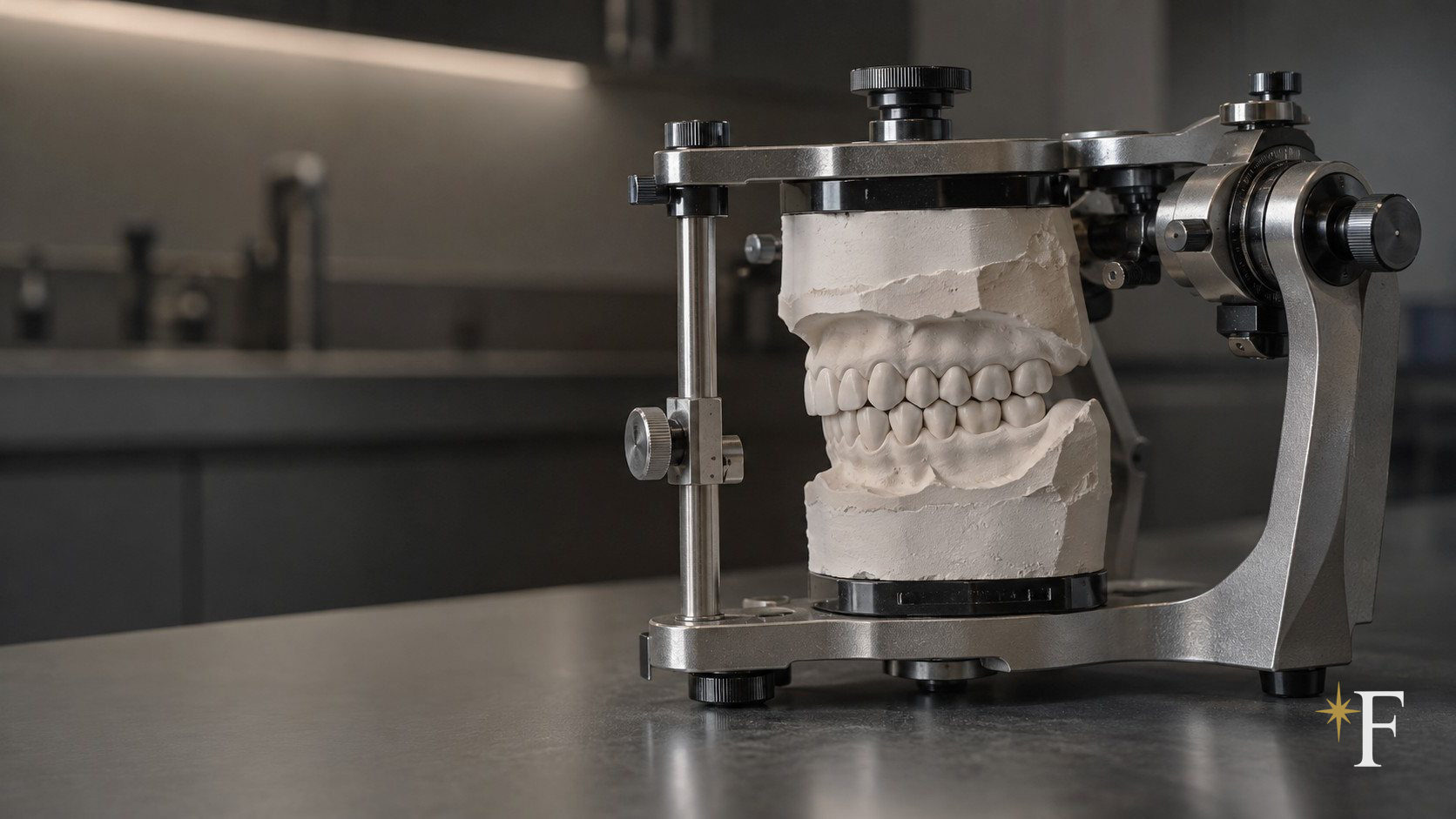
The second is what loads it. In a study of 323 veneers, 170 of them placed in patients with bruxism activity, the failures did not distribute evenly: of 13 fractures and 29 debondings recorded, 8 of the fractures and 22 of the debondings occurred in the bruxism group. The authors also found that the use of occlusal splints was associated with fewer fractures. That was an observational study of 70 patients, so it shows an association rather than proving cause, and it does not establish that every patient who grinds needs the same appliance.
These studies reinforce the importance of the bonding substrate and functional loading. They do not make material selection, preparation design or bonding technique irrelevant. A successful veneer depends on how those decisions work together.
Why load is the half that gets skipped
Preserving enamel is already standard advice, taught everywhere and argued about constantly. Assessing how a particular bite distributes force is harder to reduce to a rule, and it is the part of the planning I am particularly careful not to overlook. I should be clear that this is a clinical priority I hold, not something the studies above were designed to test.
There is a complication in the data that makes the point better than I could. In the 580-veneer series, recorded attrition showed no significant influence on failure, while in the other study a diagnosis of parafunction tracked with most of the fractures and debondings. Those are not contradictory so much as different measurements. Worn surfaces are evidence that something happened at some point. They are not a measurement of how this bite loads these teeth now, under this patient's habits, and that distinction is only settled by examining it.
Which is why the question I want answered before any ceramic is designed is not which material to use. It is where the contacts land, what happens when the jaw moves sideways and forwards, and whether anything is going on at night. If a tooth has also started to move rather than the restoration, that is a different problem with a different urgency.
If veneers you already have keep chipping or coming loose, the useful appointment examines the load before it replaces the ceramic, because a second set made to the same scheme inherits the same forces. That is where an assessment of existing veneers starts.
References
- Gurel G, Sesma N, Calamita MA, Coachman C, Morimoto S. Influence of enamel preservation on failure rates of porcelain laminate veneers. International Journal of Periodontics and Restorative Dentistry, 2013.
- Granell-Ruíz M, Agustín-Panadero R, Fons-Font A, Román-Rodríguez JL, Solá-Ruíz MF. Influence of bruxism on survival of porcelain laminate veneers. Medicina Oral Patología Oral y Cirugía Bucal, 2014.
- Etienne O, Wang CJ, Bourgi R, Watzki D, Roman T. Survival of ceramic veneers: impact of dentin exposure and tooth vitality after 1 to 15 years of follow-up. Journal of Esthetic and Restorative Dentistry, 2025.
- Klein P, Spitznagel FA, Zembic A, et al. Survival and complication rates of feldspathic, leucite-reinforced, lithium disilicate and zirconia ceramic laminate veneers: a systematic review and meta-analysis. Journal of Esthetic and Restorative Dentistry, 2025.
About the author
Dr. Omar Fabbro, DDS, Università dell'Aquila, Italy
Italian cosmetic and restorative dentist, practising in his own private practice in Jumeirah, Dubai. He qualified in Italy, invested five years in the university orthodontics and gnathology department, holds postgraduate clinical diplomas in orthognathic and gnathological therapy from L'Aquila and in dental implantology, and has five publications on occlusion and jaw function.